Are you looking for the Bengali Calendar February 2026 (বাংলা ক্যালেন্ডার ফেব্রুয়ারি ২০২৬)? You are in exactly the right place. February 2026 may be the shortest month of the Gregorian year, but in the Bangla Panjika, it stands as one of the most spiritually intense and culturally meaningful months of the entire calendar.
The Bangla Calendar February 2026 spans two sacred Bengali months — Magh (মাঘ) in its first half and Phalguna (ফাল্গুন) in its second half — both belonging to Bangabda 1432. These two late-winter months carry within them some of Hinduism’s most revered observances: the sacred full-moon bath of Magha Purnima, the supreme night of Shiva worship on Maha Shivratri, two significant Ekadashi fasting days, the solemn power of Phalguna Amavasya, and the profoundly emotional observance of International Mother Language Day — a date no Bengali anywhere in the world can approach without feeling the weight of history and the pride of language.
Bengali Calendar February 2026 – Month Overview
| Detail | Information |
|---|---|
| Bengali Month (First Half) | Magh (মাঘ) — 10th Month, Bangabda 1432 |
| Bengali Month (Second Half) | Phalguna (ফাল্গুন) — 11th Month, Bangabda 1432 |
| Bengali Year | Bangabda 1432 |
| Calendar System | Solar-Lunar — Surya Siddhanta & Bisuddha Siddhanta |
| Season | Late Winter (Shishir) transitioning to Spring (Basanta) |
| Key Astronomical Events | Magha Purnima (Feb 1), Phalguna Amavasya (Feb 17) |
| Public Holidays | Maha Shivratri (Feb 15), Mother Language Day (Feb 21) |
| Bank Holidays | Feb 14 (2nd Sat), Feb 28 (4th Sat) |
| Cultural Mood | Deep devotion, ancestral reverence, linguistic pride, and spring anticipation |
How to Download Bengali Calendar February 2026 PDF for Free
The Bengali Calendar February 2026 PDF is available for free from multiple trusted sources:
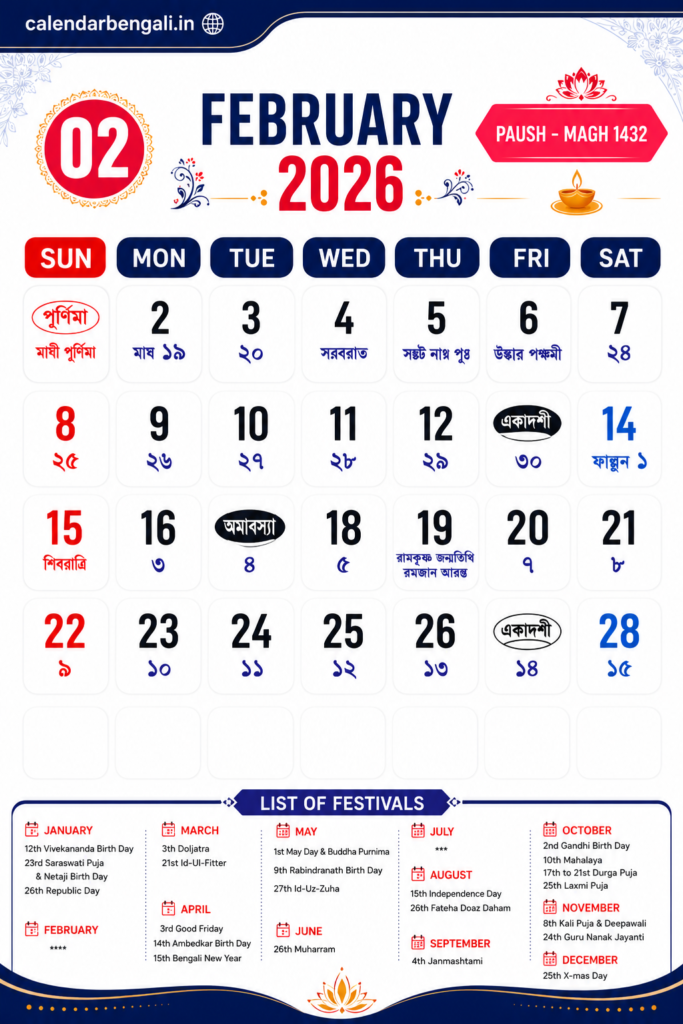
Bengali Calendar February 2026 – Complete Day-by-Day Festival & Holiday Table
| Date | Day | Festival / Holiday | Type |
|---|---|---|---|
| February 1, 2026 | Sunday | Magha Purnima (Snan & Dan) | Auspicious Full Moon — Magh |
| February 12, 2026 | Thursday | Vijaya Ekadashi | Vrat — Magh Krishna Ekadashi |
| February 14, 2026 | Saturday | Second Saturday | Bank Holiday — All India |
| February 15, 2026 | Sunday | Maha Shivratri | Major Hindu Festival / State Holiday |
| February 17, 2026 | Tuesday | Phalguna Amavasya | New Moon — Ancestor Rituals |
| February 21, 2026 | Saturday | International Mother Language Day (Shaheed Dibash) | Cultural / National Observance |
| February 27, 2026 | Friday | Amalaki Ekadashi | Vrat — Phalguna Shukla Ekadashi |
| February 28, 2026 | Saturday | Fourth Saturday | Bank Holiday — All India |
Detailed Guide to Every Festival & Observance – Bengali Calendar February 2026
1. Magha Purnima (Snan and Dan) – February 1, 2026 (Sunday)
Type: Most Auspicious Full Moon of the Year — Magh Month
Magha Purnima on Sunday, February 1, 2026 is one of the holiest days in the entire annual Hindu calendar — a full moon of extraordinary spiritual potency that falls on the final Purnima of the Bengali month of Magh. For Bengali Hindus, this is a day of sacred bathing, charitable giving, and ancestral offerings that ranks among the most meritorious days of the entire year.
Why Is Magha Purnima So Special? The Hindu texts — including the Skanda Purana, Padma Purana, and various Smriti texts — declare that the entire month of Magh is sacred, and that the Purnima that concludes it carries the accumulated spiritual power of the entire month’s devotion. Bathing in a holy river on Magha Purnima is described in the scriptures as equivalent in merit to completing an entire year of pilgrimage. Taking a dip in the Ganges, offering water to the Sun, performing charity, and feeding the needy on this day is considered an act of profound piety that benefits both the devotee and their ancestors.
2. Vijaya Ekadashi – February 12, 2026 (Thursday)
Type: Vrat — Magh Krishna Ekadashi (Ekadashi of Victory)
Vijaya Ekadashi falls on Thursday, February 12, 2026 — the eleventh day of the dark fortnight (Krishna Paksha) of the Bengali month of Magh. This Ekadashi derives its powerful name from the Sanskrit word Vijaya, meaning victory — because tradition holds that observing this fast grants the devotee victory over life’s most formidable challenges: personal obstacles, ill health, financial difficulties, negative karma, and spiritual hindrances.
The Ramayana Connection: Vijaya Ekadashi carries one of the most dramatic origin stories of any Ekadashi in the Hindu calendar. According to the Brahma-Vaivarta Purana, when Lord Rama stood at the shore of the ocean seeking a way to cross to Lanka and rescue Goddess Sita, the sage Bakadalbhya advised him to observe Vijaya Ekadashi fast. Lord Rama observed the fast with complete devotion, and his subsequent victory over the demon king Ravana is attributed in part to the extraordinary spiritual merit and divine favour generated by this fast. This connection to the Ramayana makes Vijaya Ekadashi particularly meaningful to Vaishnava devotees.
3. Maha Shivratri – February 15, 2026 (Sunday)
Type: Major Hindu Festival — Grand Annual Night of Shiva Worship
Maha Shivratri on Sunday, February 15, 2026 is the supreme celebration of Lord Shiva in the entire Hindu calendar — the one night of the year when the cosmic energy of Shiva is believed to be most powerfully present, most directly accessible, and most responsive to sincere devotion. Every month has a Shivratri (the 13th or 14th night of the dark fortnight), but Maha Shivratri — the Great Night of Shiva — comes only once a year and carries a magnitude of spiritual significance that surpasses all the monthly Shivratris combined.
Nishita Kaal (Midnight Puja Window): The most auspicious puja window of Maha Shivratri is the Nishita Kaal — the midnight hour considered the exact time of Shiva’s manifestation. For precise Nishita Kaal and Chaturdashi Tithi timings for your city, always refer to the official Bengali Calendar February 2026 PDF.
4. Phalguna Amavasya – February 17, 2026 (Tuesday)
Type: New Moon — Ancestral Offerings and Pitru Tarpan
Phalguna Amavasya on Tuesday, February 17, 2026 is the new moon day of the Bengali month of Phalguna — a deeply significant date in the Bengali Panjika for ancestral worship, Pitru Tarpan, and Shradh rituals.
In the Bengali tradition, every Amavasya carries the energy of connection between the living and the departed. The new moon’s dark sky is understood as a symbolic space of quiet — a moment when the boundary between the material world and the ancestral realm becomes permeable, making Amavasya ideal for offering prayers, water, and sesame to forebears.
5. International Mother Language Day – February 21, 2026 (Saturday)
Type: Cultural and National Observance — Shaheed Dibash
International Mother Language Day on Saturday, February 21, 2026 is the most emotionally charged cultural observance in the entire Bengali calendar — a date that sits at the intersection of language, sacrifice, identity, and the indestructible Bengali spirit.
The Historic Events of February 21, 1952: On this day in Dhaka (then East Pakistan), university students and activists marched in defiance of a Pakistani government decree that sought to impose Urdu as the sole national language, effectively silencing the Bengali-speaking majority of East Pakistan. Police opened fire on the peaceful protesters. Five young men — Abul Barkat, Rafiquddin Ahmed, Abul Jabbar, Shafiqur Rahman, and Shahjahan Nabi — fell as martyrs, giving their lives for the right to speak, learn, and live in their mother tongue.
6. Amalaki Ekadashi – February 27, 2026 (Friday)
Type: Vrat — Phalguna Shukla Ekadashi (Most Auspicious Ekadashi)
Amalaki Ekadashi on Friday, February 27, 2026 is one of the most revered Ekadashi observances in the Vaishnava calendar and falls on the eleventh day of the bright fortnight (Shukla Paksha) of Phalguna. This Ekadashi holds a unique distinction — it is the only Ekadashi on which a tree, rather than an idol, is the primary object of worship.
The Sacred Amla Tree and Lord Vishnu: On Amalaki Ekadashi, the Amla tree (Indian Gooseberry / Phyllanthus emblica) is worshipped as a living embodiment of Lord Vishnu. According to Padma Purana tradition, Lord Vishnu himself resides within the Amla tree during the month of Phalguna, making the tree a living temple during this period.
Bank Holidays in West Bengal – February 2026
| Date | Day | Holiday | Type |
|---|---|---|---|
| February 14, 2026 | Saturday | Second Saturday | Bank Holiday — All India (RBI) |
| February 28, 2026 | Saturday | Fourth Saturday | Bank Holiday — All India (RBI) |
Notes for Bank Customers:
- Both bank holidays in February 2026 fall on Saturdays — meaning no working weekdays are affected by bank closures this month
- Maha Shivratri (February 15, Sunday) may be observed as a local bank holiday in some states — verify with your West Bengal bank branch
- UPI, IMPS, and ATMs remain fully operational on all bank holidays
- NEFT and RTGS real-time settlement is typically suspended on bank holidays at branches — plan large transactions for working days
Ekadashi Dates in February 2026 – Quick Reference
| Date | Day | Ekadashi Name | Paksha | Significance |
|---|---|---|---|---|
| February 12, 2026 | Thursday | Vijaya Ekadashi | Magh Krishna Paksha | Grants victory over all obstacles. Connected to Lord Rama’s preparation before the Lanka campaign |
| February 27, 2026 | Friday | Amalaki Ekadashi | Phalguna Shukla Paksha | Amla tree worshipped as Lord Vishnu. One of the most spiritually powerful Ekadashis of the year |
Important for Fasting Devotees: The Parana time (the window for correctly breaking the Ekadashi fast on the following Dwadashi) varies by location and tithi timing. Always consult the official Bengali Panjika February 2026 PDF or your local pandit for city-specific accurate Parana timings.
Magh and Phalguna – The Late Winter Months of Bangla Panjika
Understanding the cultural and spiritual character of Magh and Phalguna enriches the experience of the Bengali Calendar February 2026:
Magh (মাঘ) — The Month of Sacred Cold: Magh is the 10th month of the Bengali year and falls in the heart of winter. The cold of Magh (called Maghi thanda — the cold of Magh — in Bengali folk speech) is considered the sharpest cold of the year. Yet this same biting cold is embraced as a spiritual discipline — devotees who bathe at dawn in cold river water during Magh are believed to receive exceptional merit. The entire month of Magh is considered auspicious for bathing, charity, and Vishnu worship, culminating in the grand Magha Purnima.
Phalguna (ফাল্গুন) — The Gateway to Spring: Phalguna is the 11th and penultimate month of the Bengali year — the month when winter exhales its last breath and spring begins to arrive. In Bengali culture, Phalguna is inseparable from the arrival of spring, the blooming of the palash (flame of the forest) trees in vivid orange-red, and the approaching festival of Holi (Dol Purnima). Phalguna is also the month when the season of Basanta (spring) officially begins in the Bengali calendar — bringing with it a sense of renewal, colour, and cultural celebration that sets the stage for Holi and the approaching new year in Boishakh.
Frequently Asked Questions (FAQs)
Q1. When is Maha Shivratri in the Bengali Calendar February 2026?
Maha Shivratri falls on Sunday, February 15, 2026. It is the grandest night of Shiva worship in the entire Hindu calendar — observed with four prahar pujas through the night, full day and night fasting, and all-night vigil. Shiva temples across West Bengal remain illuminated and filled with devotees throughout the night.
Q2. When is Magha Purnima in February 2026?
Magha Purnima falls on Sunday, February 1, 2026 — the full moon of the Bengali month of Magh. It is one of the holiest bathing and charity days of the year. A holy dip in the Ganges on this day is scripturally equivalent in merit to a year of pilgrimage.
Q3. What Bengali month is February 2026?
February 2026 covers two Bengali months — Magh (মাঘ) for the first half and Phalguna (ফাল্গুন) for the second half — both in Bangabda 1432.
Q4. What are the Ekadashi dates in February 2026 in the Bengali Calendar? February 2026 has two Ekadashis: Vijaya Ekadashi on February 12 (Magh Krishna Ekadashi — grants victory over obstacles) and Amalaki Ekadashi on February 27 (Phalguna Shukla Ekadashi — Amla tree worshipped as Vishnu, one of the most auspicious Ekadashis of the year).
Q5. What is International Mother Language Day and why is it so important to Bengalis?
International Mother Language Day on February 21, 2026 commemorates the Bengali-language martyrs of Dhaka who were killed by Pakistani police on February 21, 1952, while peacefully protesting for the right to use their mother tongue. UNESCO declared this date a global observance in 1999 in their honour. For Bengalis worldwide, it is one of the most emotionally significant dates in the entire calendar.
Conclusion
The Bengali Calendar February 2026 proves that the briefest month of the Gregorian year can carry the deepest spiritual and cultural weight. It opens with the luminous holiness of Magha Purnima on February 1 — calling devotees to the river before dawn. It deepens through the victorious fast of Vijaya Ekadashi and reaches its most magnificent peak with Maha Shivratri — the supreme night of cosmic Shiva energy on February 15.